2024春实验标准答案和常见错误
lab2
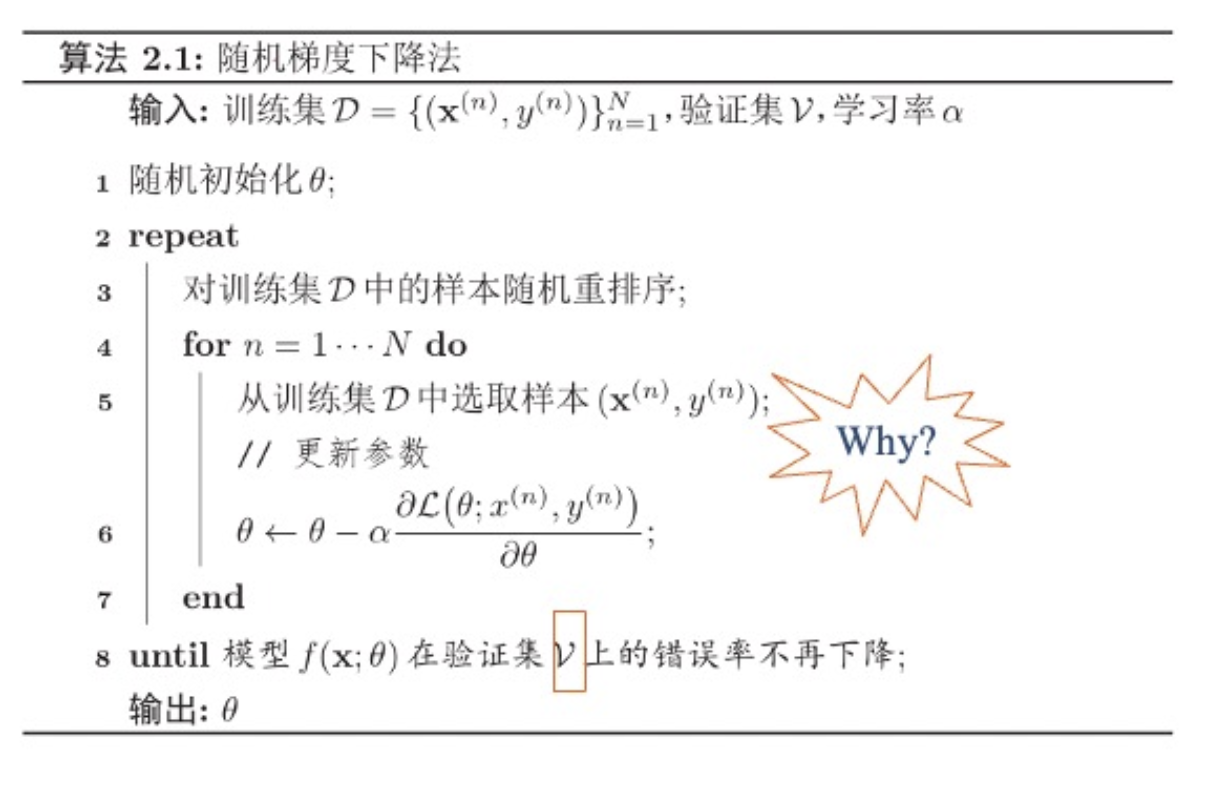
标准答案:
def train(self, x, y, k = 8):
  '''
  x and y are the data for traning a linear regression
  k is the batch size
  please simply update the value of self.w and not include any other parameters
  '''

  # ===========
  # todo '''使用小批量随机梯度下降法优化对self.w进行更新'''

  beta0 = np.expand_dims(np.ones_like(x), axis=1)
  beta1 = np.expand_dims(x, axis=1)
  x = np.concatenate([beta1, beta0], axis=1)

  for i in range(self.epoch):
        ids = np.arange(len(x))
    random.shuffle(ids)

    iter_num = int(np.ceil(len(x)*1./k))
    for n in range(iter_num):
        delta_w = []
        for j in ids[n*k: (n+1)*k]:
            xii = x[j]
            yii = y_train[j]
            delta_w += [np.dot(xii, yii - np.dot(xii, self.w))]
        self.w += self.lr*(np.mean(delta_w, 0))
# ===========
扣分点:没有使用到小批量
def train(self, x, y, k = 8):
    '''
    x and y are the data for traning a linear regression
    k is the batch size
    please simply update the value of self.w and not include any other parameters
    '''

    # ==========
    # todo '''使用小批量随机梯度下降法优化对self.w进行更新'''
    theta0 = np.expand_dims(np.ones_like(x), axis=1)
    theta1 = np.expand_dims(x, axis=1)
    theta = np.concatenate([theta1, theta0], axis=1)
    for i in range(self.epoch):
        print("循环次数: ", i, "参数 w_train = ", self.w)
        grad = theta.T.dot(theta.dot(self.w)-y)*2.0/len(theta)
        self.w=self.w-self.lr*grad
    # ==========
扣分点:没有随机
def train(self, x, y, k=8):

    n = x.shape[0]
    for _ in range(self.epoch):
        for i in range(0, n, k):

            x_batch = x[i:i+k]
            y_batch = y[i:i+k]

            beta0 = np.expand_dims(np.ones_like(x_batch), axis=1)
            beta1 = np.expand_dims(x_batch, axis=1)
            x_batch = np.concatenate([beta1, beta0], axis=1)

            y_pred = np.dot(x_batch, self.w)
            error = y_pred - y_batch

            gradient = np.dot(x_batch.T, error) / k
            self.w -= self.lr * gradient
    return self.w
扣分点:使用adam
num_batch = x.shape[0] // k
    for epoch in range(self.epoch):
        for batch in range(num_batch):
      params = {"w": self.w}
      optimizer = Adam(params, lr=self.lr)
      grad = {}
      batch_x = x[batch * k: (batch + 1) * k]
      batch_y = y[batch * k: (batch + 1) * k]
      predictions = self.predict(batch_x)
      errors = predictions - batch_y
      dw = 2 * np.dot(batch_x.T, errors) / k
      grad['w'] = dw
      self.w = optimizer.update(params, grad)['w']
扣分点:只选取第一个批量做梯度下降
w = self.w
for i in range(self.epoch):
    np.random.shuffle(data)
    x_batch = data[0:k, :2]
    y_batch = data[0:k, 2:3]
    grads = 0
    for i in range(k):
        x_ = np.array(x_batch[i])
        y_ = np.array(y_batch[i])
        x_.resize(len(x_), 1)
        y_.resize(len(y_), 1)
        c = np.matmul(-1 * x_, y_ - np.matmul(x_.T, w))
        grads = grads + c[0]

    grads = grads / k
    w = w - grads * self.lr
lab3
参考答案
def softmax(X):
    '''
    X is the input
    PLease compute its softmax outputs
    '''

    X_exp = X.exp()
    partition = X_exp.sum(dim=1, keepdim=True)
    return X_exp / partition
def manual_backward(self, X, y, y_hat):
    '''
    X is the input feature;
    y is the ground truth label;
    y_hat is the predicted label.
    PLease update self.linear.weight and self.linear.bias
    '''

    with torch.no_grad():
        y_onehot = torch.nn.functional.one_hot(y.long(), self.num_classes)
        delta_w = - torch.matmul(torch.t(X), (y_hat - y_onehot))/y.size(0)
        self.linear.weight += self.lr * torch.t(delta_w)
        delta_b = - torch.sum((y_hat - y_onehot), dim=0)/y.size(0)
        self.linear.bias += self.lr * delta_b
扣分点:偏导数没算对
def manual_backward(self, X, y, y_hat):
    with torch.no_grad():
        self.linear.weight -= self.lr * torch.matmul(X.T, (y_hat - y))
        self.linear.bias -= self.lr * torch.sum(y_hat - y ,dim = 0)
扣分点:没有更新偏置
def manual_backward(self, X, y, y_hat):
    with torch.no_grad():
        alpha = 0.0001
        N = X.shape[0]
        # y: 1,2,0 --> [010][001][100]
        y_cp = torch.zeros(y.shape[0], 3)
        y_cp[torch.arange(y.shape[0]), y.long()] = 1

        dW = -1 / N * (y_cp - y_hat).T @ X
        self.linear.weight -= alpha * dW
lab4
标准答案
class Relu:
    def __init__(self):
        self.mem = {}

    def forward(self, x):
        self.mem['x'] = x
        return np.where(x > 0, x, np.zeros_like(x))

    def backward(self, grad_y):
        '''
        grad_y: same shape as x
        '''

        # ==========
        # todo '''请完成激活函数的梯度后传'''
        # ==========
        x = self.mem['x']
        return (x > 0).astype(np.float32) * grad_y
    def compute_loss(self, log_prob, labels):
        '''
        log_prob is the predicted probabilities
        labels is the ground truth
        Please return the loss
        '''

        # ==========
        # todo '''请完成多分类问题的损失计算 损失为: 交叉熵损失 + L2正则项'''
        # ==========
        loss = np.sum(np.sum(-log_prob * labels, axis=1)) + self.lambda1 * (np.sum(self.W1 ** 2) + np.sum(self.W2 ** 2)) * 0.5

        return loss
    def forward(self, x):
        '''
        x is the input features
        Please return the predicted probabilities of x
        '''

        # ==========
        # todo '''请搭建一个MLP前馈神经网络 补全它的前向传播 MLP结构为FFN --> RELU --> FFN --> Softmax'''
        # ==========
        x = x.reshape(x.shape[0], -1)
        bias = np.ones(shape=[x.shape[0], 1])
        x = np.concatenate([x, bias], axis=1) # (batch_size, num_inputs+1)

        self.h1 = self.mul_h1.forward(self.W1, x.T)
        self.h1_relu = self.relu.forward(self.h1)
        self.h2 = self.mul_h2.forward(self.W2, self.h1_relu)
        self.h2_soft = self.softmax.forward(self.h2.T)
        self.h2_log = self.log.forward(self.h2_soft)
        return self.h2_log
    def backward(self, label):
        '''
        label is the ground truth
        Please compute the gradients of self.W1 and self.W2
        '''

        # ==========
        # todo '''补全该前馈神经网络的后向传播算法'''
        # ==========

        self.h2_log_grad = self.log.backward(-label)
        self.h2_soft_grad = self.softmax.backward(self.h2_log_grad)
        self.h2_grad, self.W2_grad = self.mul_h2.backward(self.h2_soft_grad.T)
        self.h1_relu_grad = self.relu.backward(self.h2_grad)
        self.h1_grad, self.W1_grad = self.mul_h1.backward(self.h1_relu_grad)
    def update(self):
        '''
        Please update self.W1 and self.W2
        '''

        # ==========
        # todo '''更新该前馈神经网络的参数'''
        # ==========
        self.W1 -= self.lr * (self.W1_grad + self.lambda1 * self.W1)
        self.W2 -= self.lr * (self.W2_grad + self.lambda1 * self.W2)
扣分点:foward最后没有经过log.forward层
def forward(self, x):
    # 第一个全连接层
    # 检查输入特征 x 的形状

    # 将输入特征扁平化为一维向量
    x_flattened = np.reshape(x, (x.shape[0], -1))

    # 添加偏置项并检查形状
    x_with_bias = np.concatenate((x_flattened, np.ones((x_flattened.shape[0], 1))), axis=1)

    # 进行矩阵乘法操作
    h1 = self.mul_h1.forward(self.W1, np.transpose(x_with_bias))
    h1_relu = self.relu.forward(h1)

    # 第二个全连接层
    h2 = self.mul_h2.forward(self.W2, h1_relu)
    probs = self.softmax.forward(h2.T)

    # 将输出的形状转置为 (60000, 10)
    self.probs = probs
    return probs
扣分点:backward label不是-label
def backward(self, label):
    grad_y = self.log.backward(label)
    grad_y = self.softmax.backward(grad_y)
    grad_y, grad_W2 = self.mul_h2.backward(grad_y.T)

    grad_y = self.relu.backward(grad_y)
    _, grad_W1 = self.mul_h1.backward(grad_y)

    self.grad_W1 = grad_W1
    self.grad_W2 = grad_W2
扣分点:更新部分写到了forward
def backward(self, label):
    grad_log = self.log.backward(label)
    grad_softmax = self.softmax.backward(grad_log)
    grad_layer2, grad_W2 = self.mul_h2.backward(grad_softmax.T)
    grad_relu = self.relu.backward(grad_layer2)
    grad_layer1, grad_W1 = self.mul_h1.backward(grad_relu)

    self.W1 += self.lr * grad_W1
    self.W2 += self.lr * grad_W2
    # ===========


def update(self):
    '''

    PLease update self.W1 and self.W2
    '''

    # ===========
    # todo '''更新该前馈神经网络的参数'''
扣分点:更新里面有backward
def update(self):
    '''

    PLease update self.W1 and self.W2
    '''

    # ===========
    # todo '''更新该前馈神经网络的参数'''
    # ===========
    grad_W1, grad_W2 = self.backward(label)  # Assuming label is defined elsewhere
    self.W1 -= self.lr * grad_W1
    self.W2 -= self.lr * grad_W2
lab5
未放出标准答案
但是实验课有提到nn.Unfold以后不能再使用了(确实有点投机取巧哈哈)
另外一套可行的代码:
import torch
from torch import nn


def corr2d(X, K):
    '''
    X --> (B, I, H, W) where B = batch size, I = in_channel, H = height of feature map, W = width of feature map
    K --> (O, I, h, w) where O = out_channel, I = in_channel, h = height of kernel, w = width of kernel
    你需要实现一个Stride为1,Padding为0的窄卷积操作
    Y的大小应为(B, O, H-h+1, W-w+1)
    '''

    # =============
    # todo: 请根据以上提示补全代码
    # =============
    B, I, H, W = X.shape
    O, _, h, w = K.shape
    X = X.unsqueeze(1)
    K = K.unsqueeze(0)
    Y = torch.zeros((B, O, H-h+1, W-w+1))
#     print(X[:, :, :, 1:1+h, 1:1+w].shape, K.shape)
#     print(torch.sum(X[:, :, :, 1:1+h, 1:1+w] * K, (3,4)).shape)
    for i in range(H-h+1):
        for j in range(W-w+1):
            Y[:, :, i, j] = torch.sum(X[:, :, :, i:i+h, j:j+w] * K, (2, 3,4))
    return Y


class Conv2D(nn.Module):
    def __init__(self, out_channels, in_channels, kernel_size):
        super(Conv2D, self).__init__()
        self.weight = nn.Parameter(torch.randn((out_channels, in_channels, kernel_size[0], kernel_size[1])))
        self.bias = nn.Parameter(torch.randn((out_channels)))

    def forward(self, X):
        '''
        X --> (B, I, H, W) where B = batch size, I = in_channel, H = height of feature map, W = width of feature map
        你需要利用以上初始化的参数weight和bias实现一个卷积层的前向传播
        Y should have size (B, O, H-h+1, W-w+1)
        '''
        # =============
        # todo: 请根据以上提示补全代码
        # =============
        Y = corr2d(X, self.weight) + self.bias.view(1, self.weight.shape[0], 1, 1)

        return Y


class MaxPool2D(nn.Module):
    def __init__(self, pool_size):
        super(MaxPool2D, self).__init__()
        self.pool_size = pool_size

    def forward(self, X):
        '''
        X --> (B, I, H, W) where B = batch size, I = in_channel, H = height of feature map, W = width of feature map
        K --> (h, w) where h = height of kernel, w = width of kernel
        你需要利用以上pool_size实现一个最大汇聚层的前向传播,汇聚层的子区域间无覆盖
        Y的大小应为(B, I, H/h, W/w)
        '''

        # =============
        # todo: 请根据以上提示补全代码
        # =============
        B, I, H, W = X.shape
        h, w = self.pool_size[0], self.pool_size[1]
        Y = torch.zeros((B, I,H//h, W//w))

        for i in range(H//h):
            for j in range(W//w):
                Y[:, :, i, j] = torch.amax(X[:, :, i*h:(i+1)*h, j*w:(j+1)*w], (2, 3))
        return Y


class ImageCNN(nn.Module):
    def __init__(self, input_size, num_outputs, in_channels, out_channels, conv_kernel, pool_kernel):
        super(ImageCNN, self).__init__()
        self.conv1 = nn.Sequential(
            Conv2D(out_channels, in_channels, conv_kernel),
            nn.ReLU()
        )
        self.pool1 = MaxPool2D(pool_kernel)
        self.linear = nn.Linear(16 * 5 * 5, num_outputs)

    def forward(self, feature_map):
        b = feature_map.size()[0]
        feature_map = self.conv1(feature_map)
        feature_map = self.pool1(feature_map)
        outputs = self.linear(feature_map.reshape(b, -1))

        return outputs
lab7
未放出标准答案
VAE/GAN实现代码(她只说看一下就好)
import torch
from torchvision import transforms
import matplotlib.pyplot as plt
from torch import nn
import numpy as np
from VAE import VAE
import GAN
import gzip

torch.manual_seed(2024)

class MNISTDataset():
    def __init__(self, data_path, train=True, transform=None):
        X, y = self.load_data(data_path, train)
        self.X = X
        self.y = y
        self.transform = transform

    def __getitem__(self, index):
        img = self.X[index]
        if self.transform is not None:
            img = self.transform(img)
        if self.y is None:
            return img
        else:
            return img, int(self.y[index])

    def __len__(self):
        return len(self.X)

    def load_data(self, data_path, train):
        y_train = None

        if train:
            with gzip.open(data_path + '-labels.gz', 'rb') as f:
                y_train = np.frombuffer(f.read(), np.uint8, offset=8)

        with gzip.open(data_path + '-images.gz', 'rb') as f:
            x_train = np.frombuffer(f.read(), np.uint8, offset=16).reshape(-1, 28, 28)
        return x_train, y_train


def load_mnist():
    train_set = MNISTDataset(r'./data/train', train=True,
                             transform = transforms.Compose([
                                         transforms.ToTensor(), #,transforms.Normalize([0.5], [0.5])
                                         ]))
    return train_set

def deprocess_img(x):
    # rescale image from [-1, 1] to [0, 1]
    return (x + 1.0) / 2.0


def loss_function(reconstruction_function, recon_x, x, mu, logvar):
    #print(recon_x[:3, :3], x[:3, :3])
    BCE = reconstruction_function(recon_x, x)
    KLD = -0.5 * torch.sum(1 + 2*logvar - torch.exp(2*logvar) - mu**2)
    return BCE + KLD

def train_with_VAE(train_set):
    #print(test_set[0]); exit()
    _, height, width = train_set[0][0].shape
    train_dataloader = torch.utils.data.DataLoader(train_set, batch_size=64, shuffle=True)

    model = VAE(width*height, 50, 10)
    optimizer = torch.optim.SGD(model.parameters(), lr=1e-5)
    loss_func = nn.BCELoss(reduction = 'sum')
    recons = []

    num_epochs = 40
    for epoch in range(1, num_epochs + 1):
        train_l_sum, train_acc_sum, n = 0., 0., 0
        for i, Xy in enumerate(train_dataloader):
            #if i> 100: continue
            X, y = Xy
            X = X.squeeze(1).view(-1, width * height)
            recon_batch, mu, logvar = model(X)
            loss = loss_function(loss_func, recon_batch, X, mu, logvar)

            # 梯度清零
            optimizer.zero_grad()
            loss.backward()
            optimizer.step()
            train_l_sum += loss.item()
            n += y.shape[0]

        if epoch % 10 == 0:
            print('epoch %d, loss %.4f' % (epoch, train_l_sum / n))
            recon_batch = recon_batch.view(-1, height, width).detach().numpy()

    recon, row_recon = [], []
    for i in range(len(recon_batch)):
        recon += [recon_batch[i, :, :]]
        if (i + 1) % 8 == 0:
            row_recon += [np.concatenate(recon, 1)]
            recon = []
    row_recon = np.concatenate(row_recon, 0)
    # print('row_recon', row_recon.shape); exit()

    fig = plt.figure()
    plt.imshow(row_recon, cmap='gray', interpolation='none')
    plt.title("Generated Images")
    plt.xticks([])
    plt.yticks([])
    plt.show()


def discriminator_loss(loss_fn, logits_real, logits_fake):
    size = logits_real.shape[0]
    true_labels = torch.ones(size, 1).float()
    false_labels = torch.zeros(size, 1).float()
    loss = loss_fn(logits_real, true_labels) + loss_fn(logits_fake, false_labels)
    return loss

def generator_loss(loss_fn, logits_fake):
    size = logits_fake.shape[0]
    true_labels = torch.ones(size, 1).float()
    loss = loss_fn(logits_fake, true_labels)
    return loss

def train_with_GAN(train_set):
    #print(test_set[0]); exit()
    noise_dim = 96
    _, height, width = train_set[0][0].shape
    train_dataloader = torch.utils.data.DataLoader(train_set, batch_size=64, shuffle=True)

    discriminator = GAN.Discriminator(width*height, 256, 256)
    generator = GAN.Generator(noise_dim, 1024, width*height)
    dis_optimizer = torch.optim.Adam(discriminator.parameters(), lr=5e-4, betas=(0.5, 0.999))
    gen_optimizer = torch.optim.Adam(generator.parameters(), lr=5e-4, betas=(0.5, 0.999))
    dis_loss_func = nn.BCELoss(reduction = 'sum')
    gen_loss_func = nn.BCELoss(reduction = 'sum')
    recons = []

    num_epochs = 5
    for epoch in range(1, num_epochs + 1):
        train_d_sum, train_g_sum, n = 0., 0., 0
        for i, Xy in enumerate(train_dataloader):
            #if i> 100: continue
            X, y = Xy
            batch_size = X.size(0)
            X = X.squeeze(1).view(-1, width * height)

            # 训练判别网络
            logits_real = discriminator(X)
            rand_noise = (torch.rand(batch_size, noise_dim) - 0.5)/0.5
            fake_images = generator(rand_noise)
            logits_fake = discriminator(fake_images)

            d_error = discriminator_loss(dis_loss_func, logits_real, logits_fake)
            dis_optimizer.zero_grad()
            d_error.backward()
            dis_optimizer.step()

            # 训练生成网络
            rand_noise = (torch.rand(batch_size, noise_dim) - 0.5)/0.5
            fake_images = generator(rand_noise)

            gen_logits_fake = discriminator(fake_images)
            g_error = generator_loss(gen_loss_func, gen_logits_fake)
            gen_optimizer.zero_grad()
            g_error.backward()
            gen_optimizer.step()

            train_d_sum += d_error.item()
            train_g_sum += g_error.item()
            n += y.shape[0]

        print('epoch %d, discriminator loss %.4f, generator loss %.4f' % (epoch, train_d_sum/n, train_g_sum/n))

    recon_batch = fake_images.view(-1, height, width).detach().numpy()
    recon_batch = deprocess_img(recon_batch)

    recon, row_recon = [], []
    for i in range(len(recon_batch)):
        recon += [recon_batch[i, :, :]]
        if (i + 1) % 8 == 0:
            row_recon += [np.concatenate(recon, 1)]
            recon = []
    row_recon = np.concatenate(row_recon, 0)

    fig = plt.figure()
    plt.imshow(row_recon, cmap='gray', interpolation='none')
    plt.title("Generated Images")
    plt.xticks([])
    plt.yticks([])
    plt.show()

if __name__ == '__main__':
    train_set = load_mnist()

    train_with_VAE(train_set)

    train_with_GAN(train_set)

import torch
from torch import nn
from torch.autograd import Variable
import torch.nn.functional as F


class VAE(nn.Module):
    def __init__(self, input_feature, h1, h2):
        super(VAE, self).__init__()
        '''
        The inference network has structure:
        h1 = ReLU(W1 x + b1)
        mu = W2 h1 + b2
        log sigma = W3 h1 + b3

        The generation network has structure:
        h1 = ReLU(W1 z + b1)
        x_{hat} = sigmoid(W2 h1 + b2)
        '''
        self.fc1 = nn.Linear(input_feature, h1)
        self.fc21 = nn.Linear(h1, h2)
        self.fc22 = nn.Linear(h1, h2)
        self.fc3 = nn.Linear(h2, h1)
        self.fc4 = nn.Linear(h1, input_feature)

    def encode(self, x):
        h1 = F.relu(self.fc1(x))
        return self.fc21(h1), self.fc22(h1)

    def reparameterize(self, mu, logvar):
        '''
        Sampling z via reparameterize:
        z = mu + sigma * epsilon
        '''
        std = 0.5 * torch.exp(logvar)
        z = torch.randn(std.size()) * std + mu
        return z

    def decode(self, z):
        h3 = F.relu(self.fc3(z))
        return torch.sigmoid(self.fc4(h3))

    def forward(self, x):
        mu, logvar = self.encode(x)
        z = self.reparameterize(mu, logvar)
        return self.decode(z), mu, logvar

class Discriminator(nn.Module):
    def __init__(self, input_feature, h1, h2):
        super(Discriminator, self).__init__()
        '''
        The discriminator has structure:
        h1 = LeakyReLU(W1 x + b1)
        h2 = LeakyReLU(W2 h1 + b2)
        h3 = sigmoid(W3 h2 + b3)
        '''
        self.fc1 = nn.Linear(input_feature, h1)
        self.act1 = nn.LeakyReLU(0.2)
        self.fc2 = nn.Linear(h1, h2)
        self.act2 = nn.LeakyReLU(0.2)
        self.fc3 = nn.Linear(h2, 1)

    def forward(self, x):
        x = self.act1(self.fc1(x))
        x = self.act2(self.fc2(x))
        x = torch.sigmoid(self.fc3(x))

        return x

class Generator(nn.Module):
    def __init__(self, noise_dim, h1, h2):
        super(Generator, self).__init__()
        '''
        The generator has structure:
        h1 = ReLU(W1 z + b1)
        h2 = ReLU(W2 h1 + b2)
        x_{hat} = tanh(W3 h2 + b3)
        '''
        self.fc1 = nn.Linear(noise_dim, h1)
        self.fc2 = nn.Linear(h1, h1)
        self.fc3 = nn.Linear(h1, h2)

    def forward(self, x):
        x = F.relu(self.fc1(x))
        x = F.relu(self.fc2(x))
        x = torch.tanh(self.fc3(x))

        return x
lab9
标准答案1
def decode(self, dec_y, enc_hidden, state, is_train=True):
    dec_embs = self.emb_layer(dec_y)  # 进行词嵌入

    trg_len = dec_y.shape[1]          # 获取了目标序列的长度
    outputs = []
    state = state.transpose(1, 0)
    for t in range(trg_len):
        scores = torch.bmm(state, enc_hidden.transpose(2, 1))                 # 计算解码器当前时间步的注意力分数
        alpha = self.softmax(scores)                                          # 转换为注意力权重(batch_size, 1, seq_len)
        cont_vec = torch.bmm(alpha, enc_hidden).squeeze(1)                    # 根据注意力权重,计算当前时间步的上下文向量
        input_vec = torch.cat([cont_vec, dec_embs[:, t, :]], 1).unsqueeze(1)  # 将上下文向量和解码器输入序列的词嵌入向量拼接在一起
        sent_hidden, state = self.decoder(input_vec, state.transpose(0, 1))   # 将当前时间步的输入向量输入到解码器中
        state = state.transpose(0, 1)                                          # 再次转置解码器的状态,以恢复原始的维度顺序。
        pred = self.linear(sent_hidden)                                        # 输出预测字符
        outputs += [pred]
    sent_outputs = torch.cat(outputs, dim=1)    # 将所有时间步的预测结果连接起来,形成最终的输出序列
    return sent_outputs, state
标准答案2
def encode(self, enc_x, state):
    enc_emb = self.emb_layer(enc_x)
    enc_hidden, state = self.encoder(enc_emb, state)
    # 对编码器的隐藏状态 enc_hidden
    # 应用一个多层感知机(MLP),然后进行平均池化操作
    state = self.mlp(enc_hidden).mean(1).unsqueeze(0)
    return enc_hidden, state
def decode(self, dec_y, enc_hidden, state, is_train=True):
    dec_embs = self.emb_layer(dec_y)  # 进行词嵌入
    trg_len = dec_y.shape[1]          # 获取解码器输入序列的长度
    outputs = []
    state = state.transpose(1, 0)

    for t in range(trg_len):
        scores = torch.bmm(state, enc_hidden.transpose(2, 1))
        alpha = self.softmax(scores)  # (batch_size, 1, seq_len)
        cont_vec = torch.bmm(alpha, enc_hidden).squeeze(1)
        input_vec = torch.cat([cont_vec, dec_embs[:, t, :]], 1).unsqueeze(1)
        sent_hidden, state = self.decoder(input_vec, state.transpose(0, 1))
        state = state.transpose(0, 1)
        # 输出预测字符
        pred = self.linear(sent_hidden)
        outputs += [pred]

    sent_outputs = torch.cat(outputs, dim=1)
    return sent_outputs, state
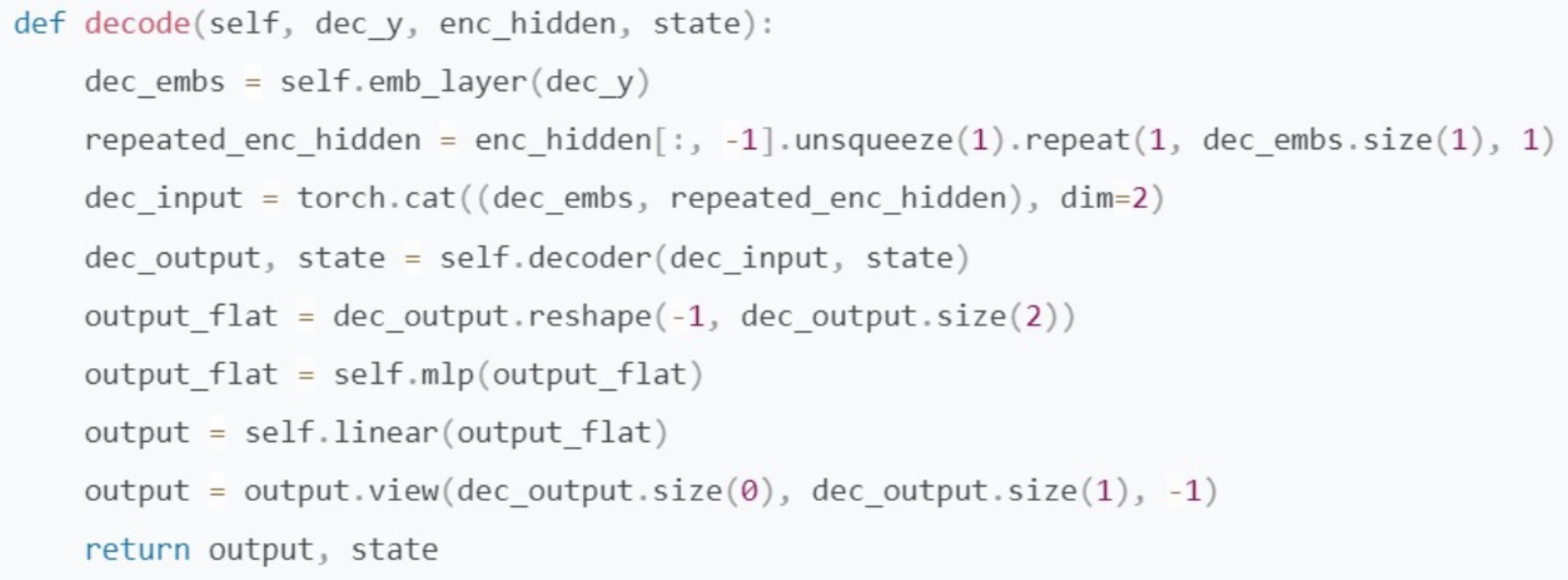
失分点:
(1)注意力机制计算错误
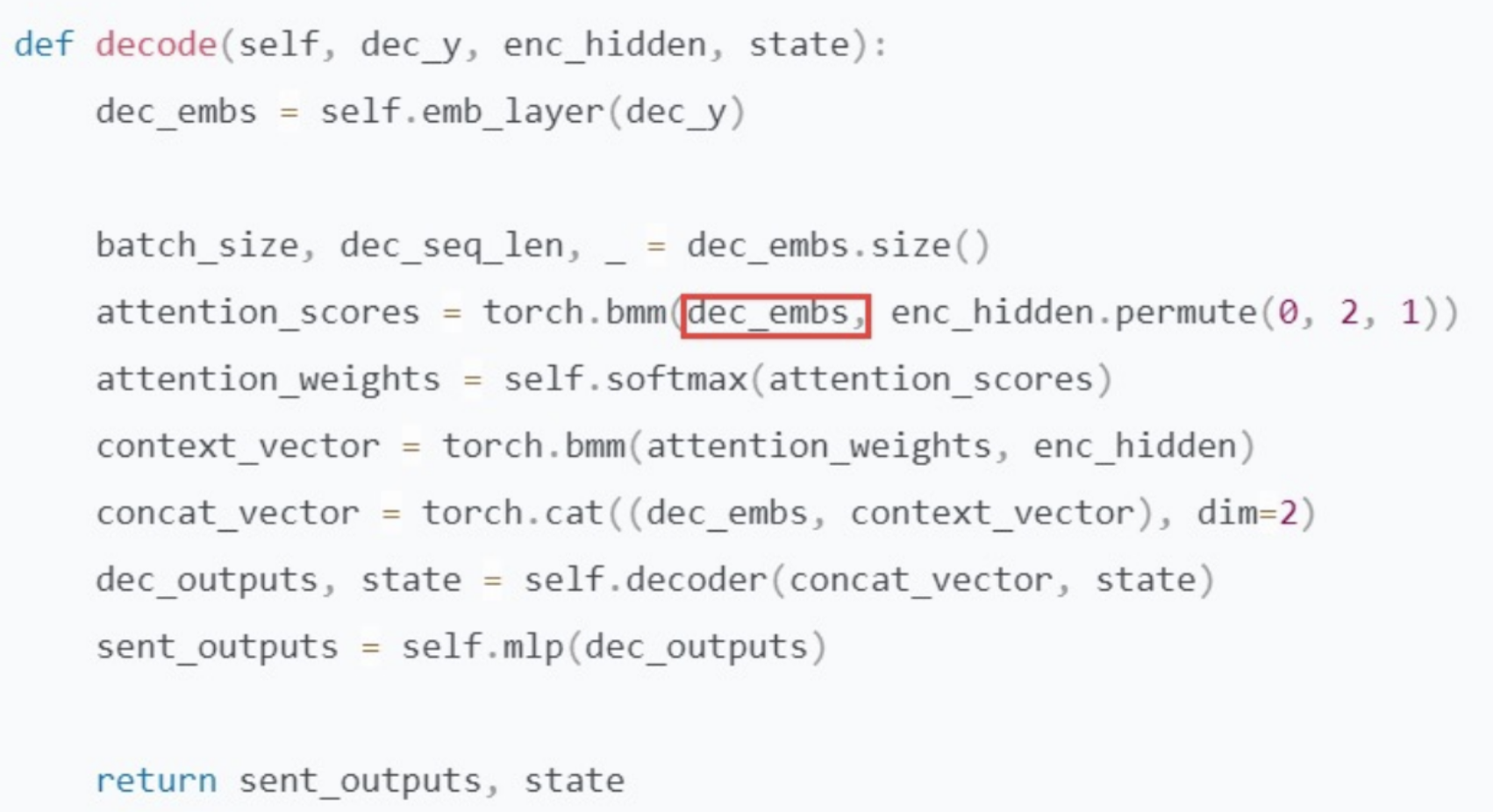
(2)注意力权重计算错误
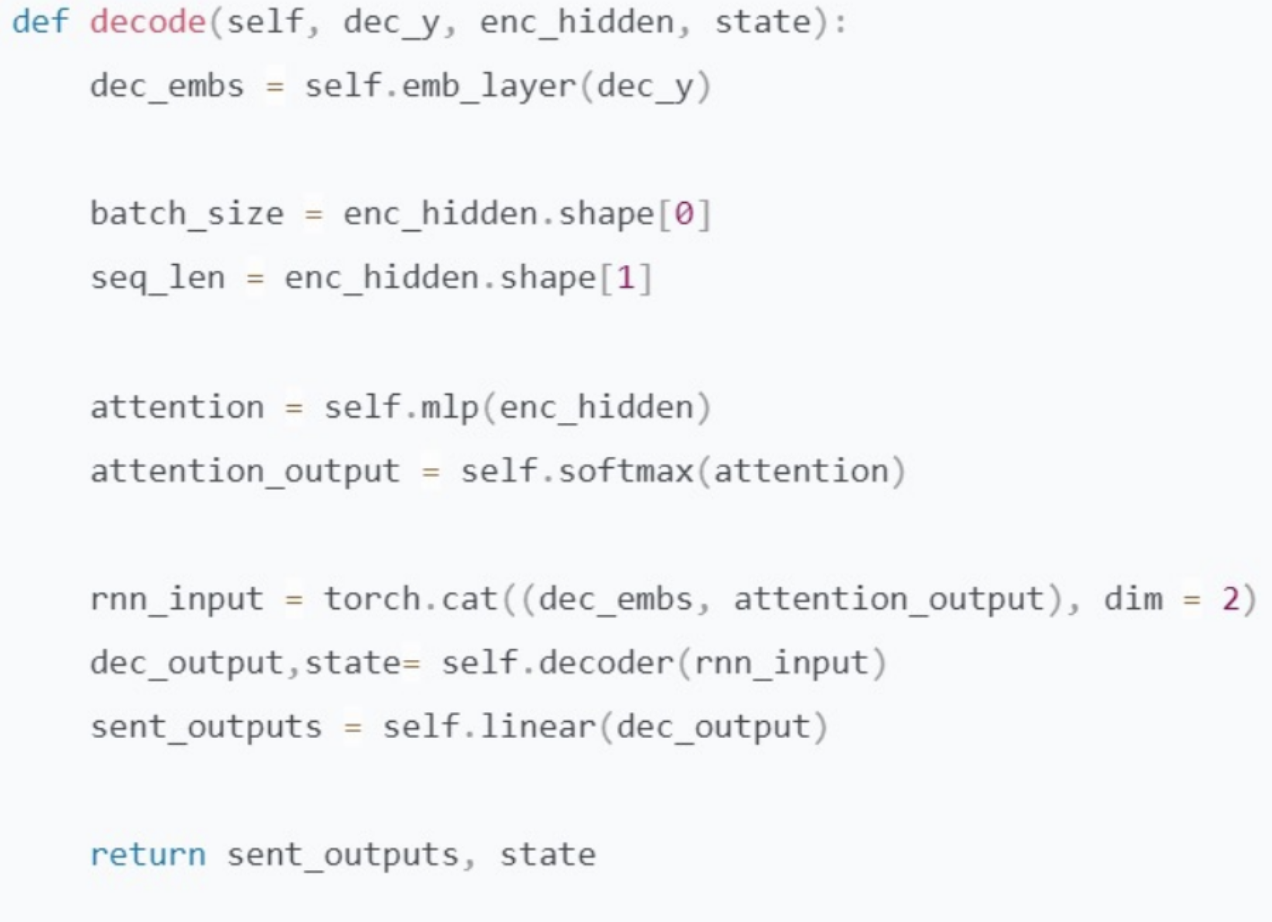
(3)没有计算注意力