4.The Acorn-Gatherer
课本页数: 75 作者: Richard Jefferies
角色 the boy; granny
往届考过的大题
第 1 小题: story 和 plot 的区别(p80)
There is no plot without causality.(因果关系) That is to say, the written piece that we call fiction is a structured pattern in which facts, characters and events are put in a special way to relate to one another through cause and effect.(其中事实、人物和事件通过因果关系以一种特殊的方式相互关联。) This is done through plotting, the manipulation of the materials by the writer so that meaning will stand out. 这是通过情节设计来完成的,作家通过操纵材料使意义突出。Thus, plotting is the process of converting story into plot, of changing chronological arrangement of incidents into a causal arrangement.情节设计(plotting)是将故事转化为情节的过程,是将事件的时间顺序排列转变为因果关系的排列。
第 2 小题:请结合本文阐释一下 short story 的特点 p2,需要背一下 short story 本身的特点以及与其他文学体裁的区别,再结合小说)
继续背 第 3 小题:小说以怎样的叙述视角展开?有什么特点?(涉及文学常识是叙述者视角 p22,本篇小说是不可靠叙述视角) unreliable narrator
第 4 小题:本篇小说的故事背景是什么(p62)
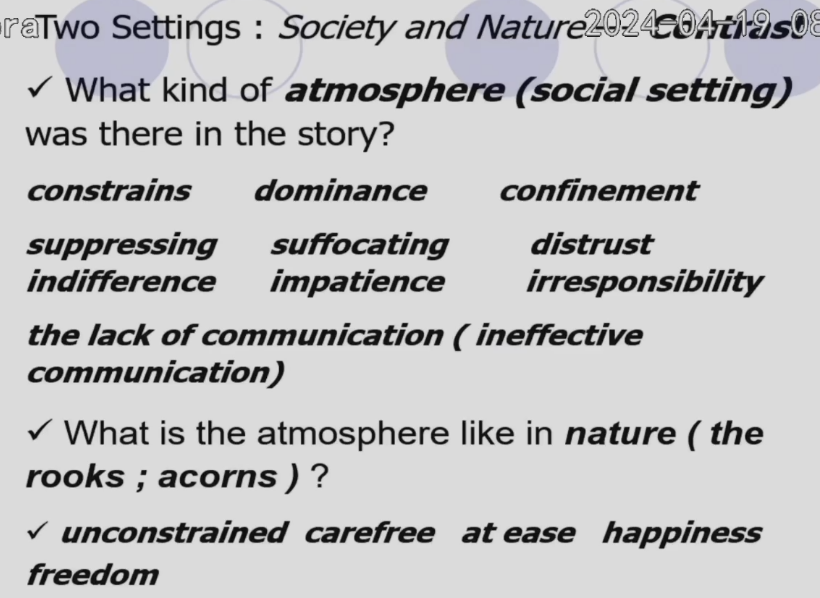
Settings:
- Geographical Setting:
- Rural England: Jefferies' works are predominantly set in the English countryside. The geographical setting for "The Acorn-Gatherer" would likely be a rural area, possibly in or near Wiltshire, where Jefferies spent much of his life.
- Natural Landscapes: The story would likely feature detailed descriptions of natural landscapes, such as woodlands, fields, and meadows, reflecting Jefferies' deep appreciation for and understanding of nature.
- Historical Setting:
- Late 19th Century: Jefferies wrote during the late Victorian era, so the historical setting for "The Acorn-Gatherer" would likely be in the latter half of the 19th century. This period was marked by significant social and technological changes, contrasting the rural, pastoral life with the rapidly industrializing cities.
- A Time of Agricultural Change: The era was also a time of change in agricultural practices and rural life in England, which could be reflected in the story's setting and themes.
- Social Setting:
- Rural Community Life: The social setting might focus on the dynamics of a small, close-knit rural community, typical of the English countryside during this period.
- Class and Social Structures: The story could explore the class dynamics and social structures of the time, perhaps contrasting the simplicity of rural life with the more complex social hierarchies of urban areas.
- Human Connection to Nature: Reflecting Jefferies' interest in the human-nature relationship, the social setting might also delve into how people's lives were intimately connected to and dependent on the natural world, a theme prevalent in his writings.
第 5 小题:小说的主题是什么?(ppt 上会给)
*Themes*:
-
Nature and Its Influence: Given the title "The Acorn-Gatherer," it's likely the story would explore the theme of nature and its impact on human life. The gathering of acorns could symbolize a simple, harmonious existence with nature.
-
Class and Social Structure: As in many of Galsworthy's works, themes of class distinctions and the impact of social structures might be prominent. The story could contrast the simple life of a rural individual with the complexities of urban or upper-class society.
-
Tradition vs. Change: Galsworthy often explored the tension between traditional values and the changing social landscape. "The Acorn-Gatherer" might delve into how a traditional way of life is challenged or altered by societal changes.
-
Individual vs. Society: The protagonist's role as an acorn gatherer might serve as a metaphor for an individual's place in society, highlighting themes of individualism, self-sufficiency, and the conflict between personal desires and societal expectations.
-
Moral Reflections: The story could also include a strong moral dimension, reflecting on the values of hard work, perseverance, and the inherent rewards of a life close to nature.
正文
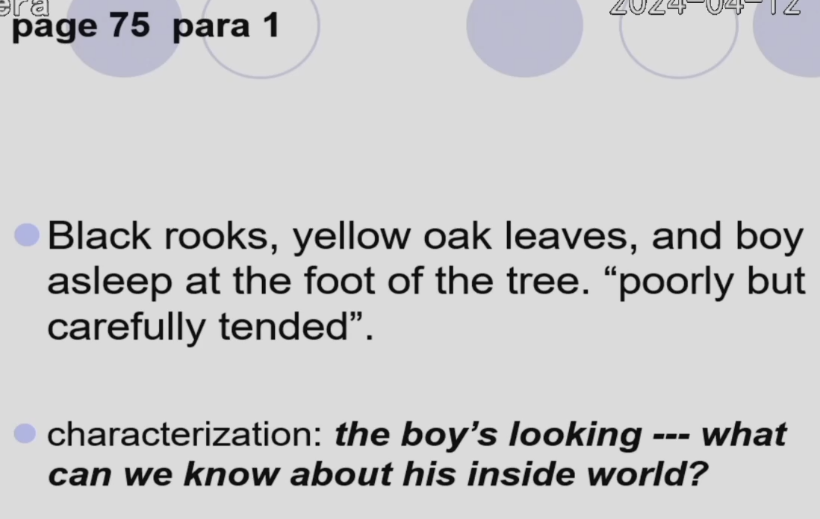
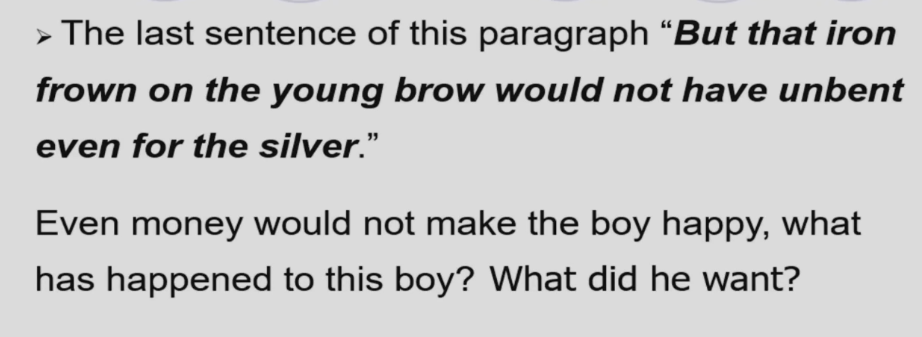
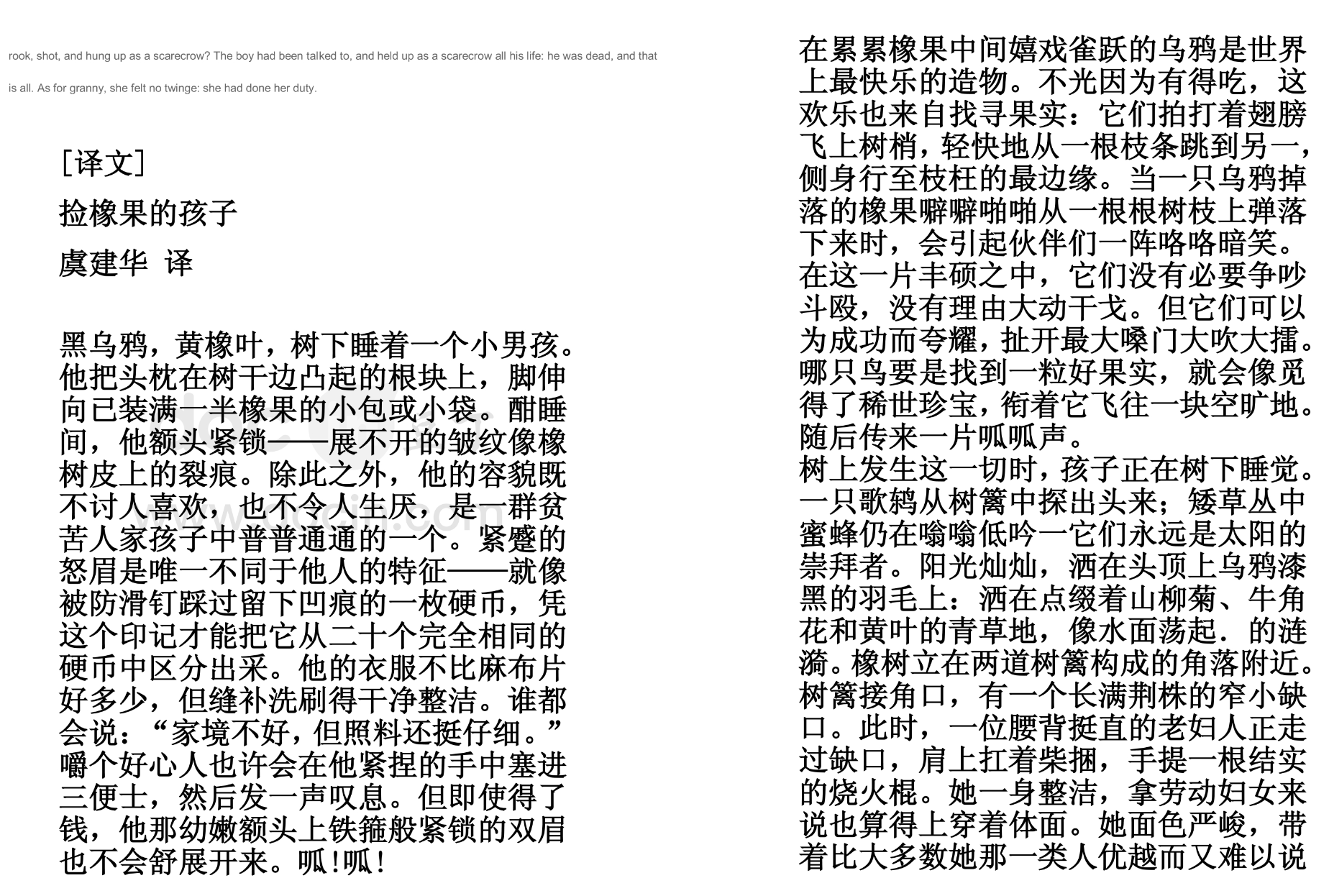
1 Black rooks, yellow oak leaves, and a boy asleep at the foot of the tree. His head was lying on a bulging root close to the stem: his feet reached to a small sack or bag half full of acorns. In his slumber his forehead frowned -they were fixed lines, like the grooves in the oak bark. There was nothing else in his features attractive or repellent: they were such as might have belonged to a dozen hedge children. The set angry frown was the only distinguishing mark – like the dents on a penny made by a hobnail boot, by which it can be known from twenty otherwise precisely similar. His clothes were little better than sacking, but dean, tidy, and repaired. Any one would have said, “Poor, but carefully tended.” A kind heart might have put a three penny-bit in his clenched little fist, and sighed. But that iron set frown on the young brow would not have unbent even for the silver. Caw! Caw!
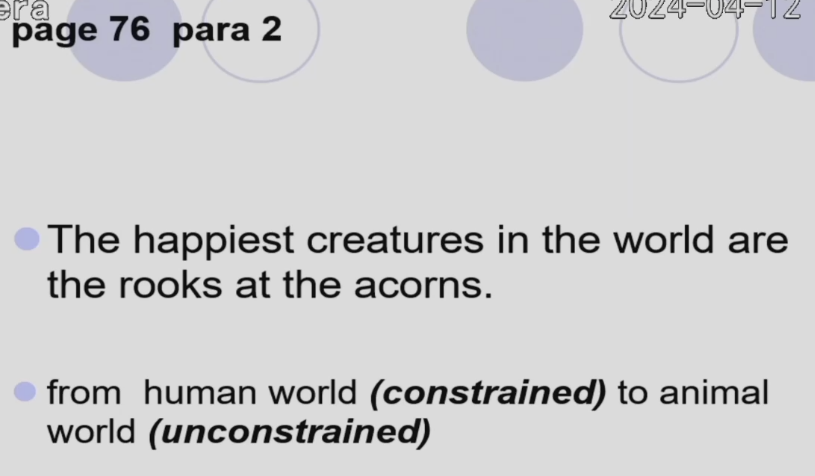
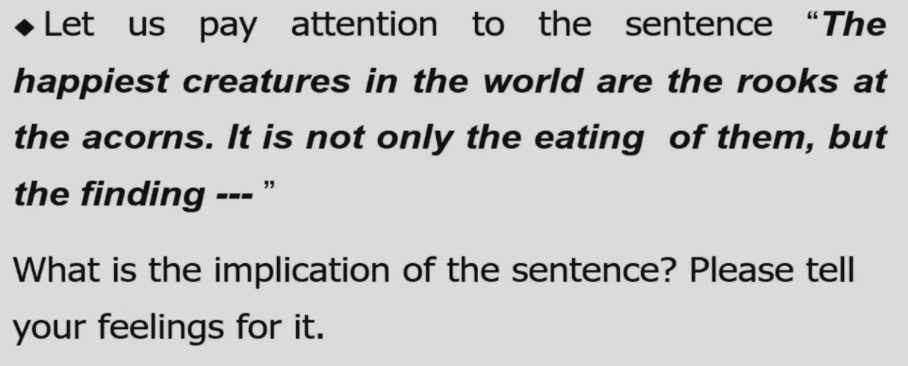
2 The happiest creatures in the world are the rooks at the acorns. It is not only the eating of them, but the finding: the fluttering up there and hopping from branch to branch, the sidling out to the extreme end of the bough, and the inward chuckling when a friend lets his acorn drop tip-tap from bough to bough. Amid such plenty they cannot quarrel or fight, having no cause of battle, but they can boast of success, and do so to the loudest of their voices. He who has selected a choice one flies with it as if it were a nugget in his beak, out to some open spot of ground, followed by a general Caw!
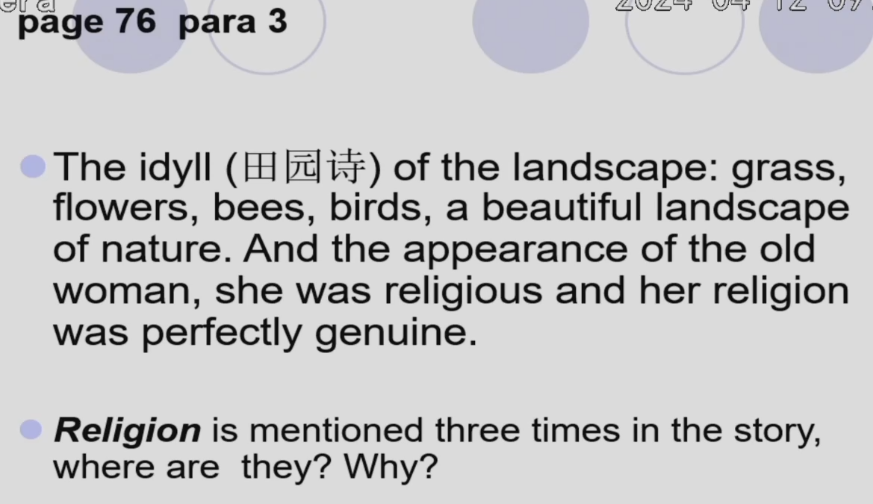
3 This was going on above while the boy slept below. A thrush looked out from the hedge, and among the short grass there was still the hum of bees, constant sun-worshippers as they are. The sunshine gleamed on the rooks’ black feathers overhead, and on the sward sparkled from hawkweed, some lotus and yellow weed, as from a faint ripple of water. The oak was near a comer formed by two hedges, and in the angle was a narrow thorny gap, presently an old woman, very upright came through this gap carrying a faggot on her shoulder and a stout ash stick in her hand. She was very clean, well dressed for a laboring woman, hard of feature, but superior in some scarcely defined way to most of her class. The upright carriage bad something to do with it, the firm mouth, the light blue eyes that looked every one straight in the face. Possibly these, however, had less effect than her conscious righteousness. Her religion lifted her above the rest, and I do assure you that it was perfectly genuine. That hard face and cotton gown would have gone to the stake.
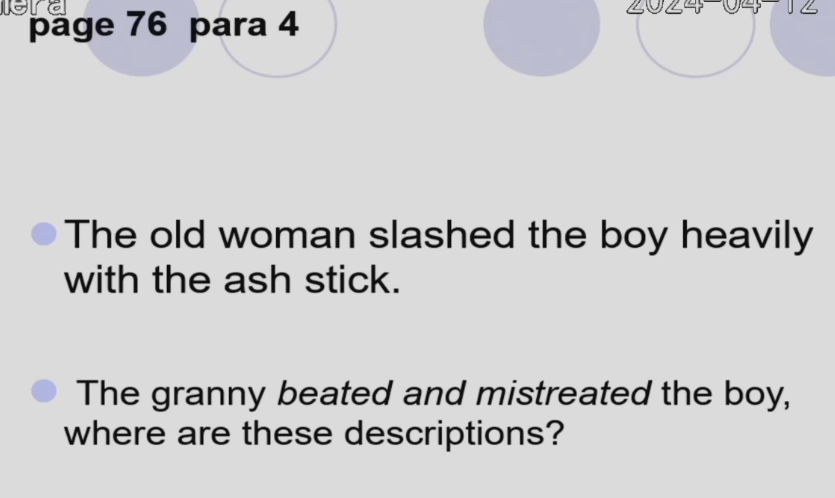
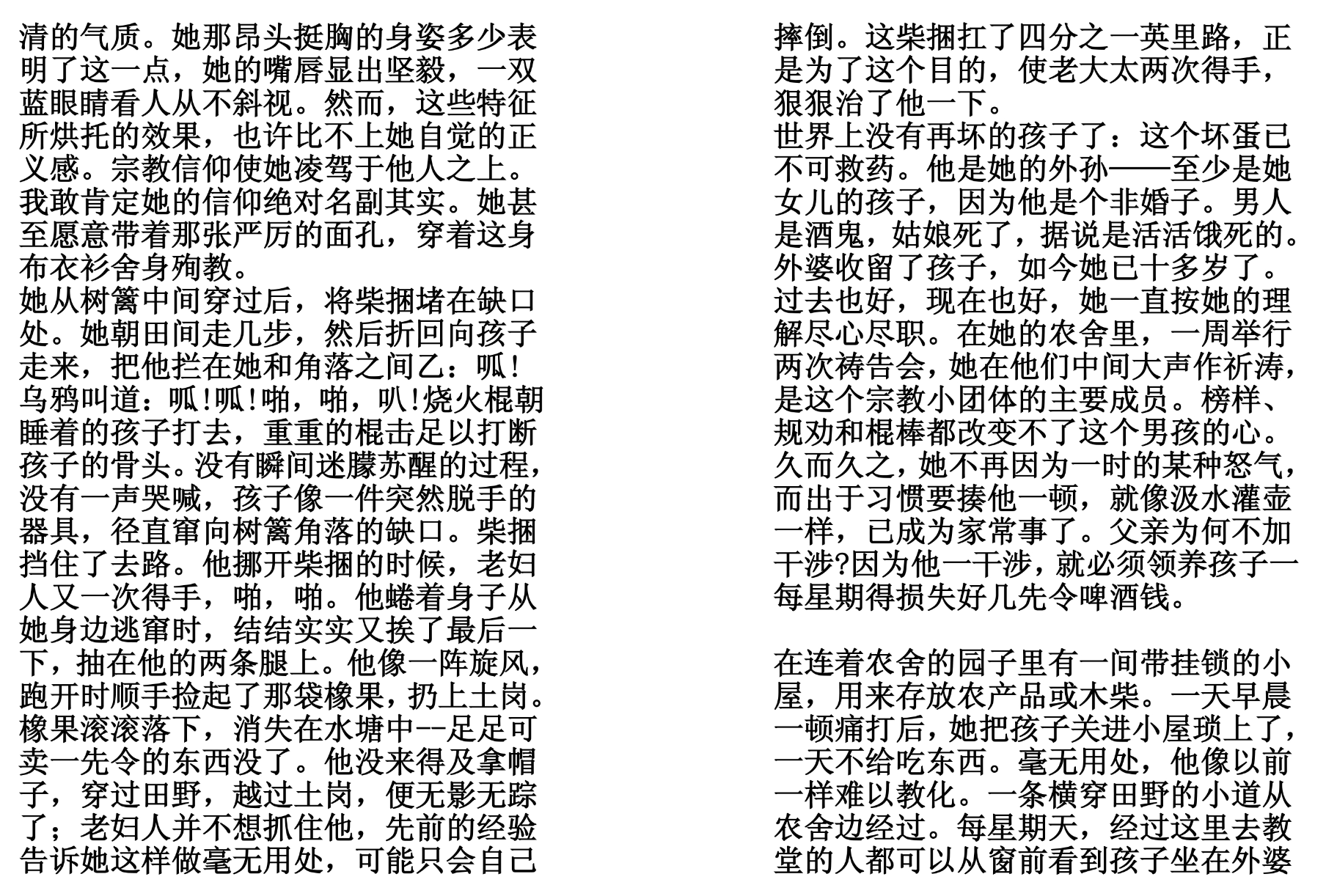
4 When she had got through the gap she put the faggot down in it, walked a short distance out into the field, and came back towards the boy, keeping him between her and the corner. Caw! said the rooks, Caw! Caw! Thwack, thwack, bang, went the ash stick on the sleeping boy, heavily enough to bare broken his bones. Like a piece of machinery suddenly let loose, without a second of dubious awakening and without a cry, he darted straight for the gap in the corner, There the faggot stopped him, and before he could tear it away the old woman had him again, thwack, thwack, and one last stinging Slash across his legs as he doubled past her. Quick as the wind as he rushed he picked up the bag of acorns and pitched it into the mound, where the acorns rolled down into a pond and were lost – a good round shilling’s worth. Then across the field, without his cap, over the rising ground, and out of sight. The old woman made no attempt to hold him, knowing from previous experience that it was useless, and would probably result in her own overthrow. The faggot, brought a quarter of a mile for the purpose, enabled her, you see, to get two good chances at him.
5 A wicked boy never lived: nothing could be done with the reprobate. He was her grandson – at least, the son of her daughter, for he was not legitimate. The man drank, the girl died, as was believed, of sheer starvation: the granny kept the child, and he was now between ten and eleven years old. She bad done and did her duty, as she understood it. A prayer-meeting was held in her cottage twice a week, she prayed herself aloud among them, she was a leading member of the sect. Neither example, precept, nor the rod could change that boy’s heart. In time perhaps she got to beat him from habit rather ‘than from any particular anger of the moment, just as she fetched water and filled her kettle, as one of the ordinary events of the day. Why did not the father interfere? Because if so he would have had to keep his son: so many shillings a week the less for ale.
6 In the garden attached to the cottage there was a small shed with a padlock, used to store produce or wood in. One morning, after a severe beating, she drove the boy in there and locked him in the whole day without food. It was no use, he was as hardened as ever.
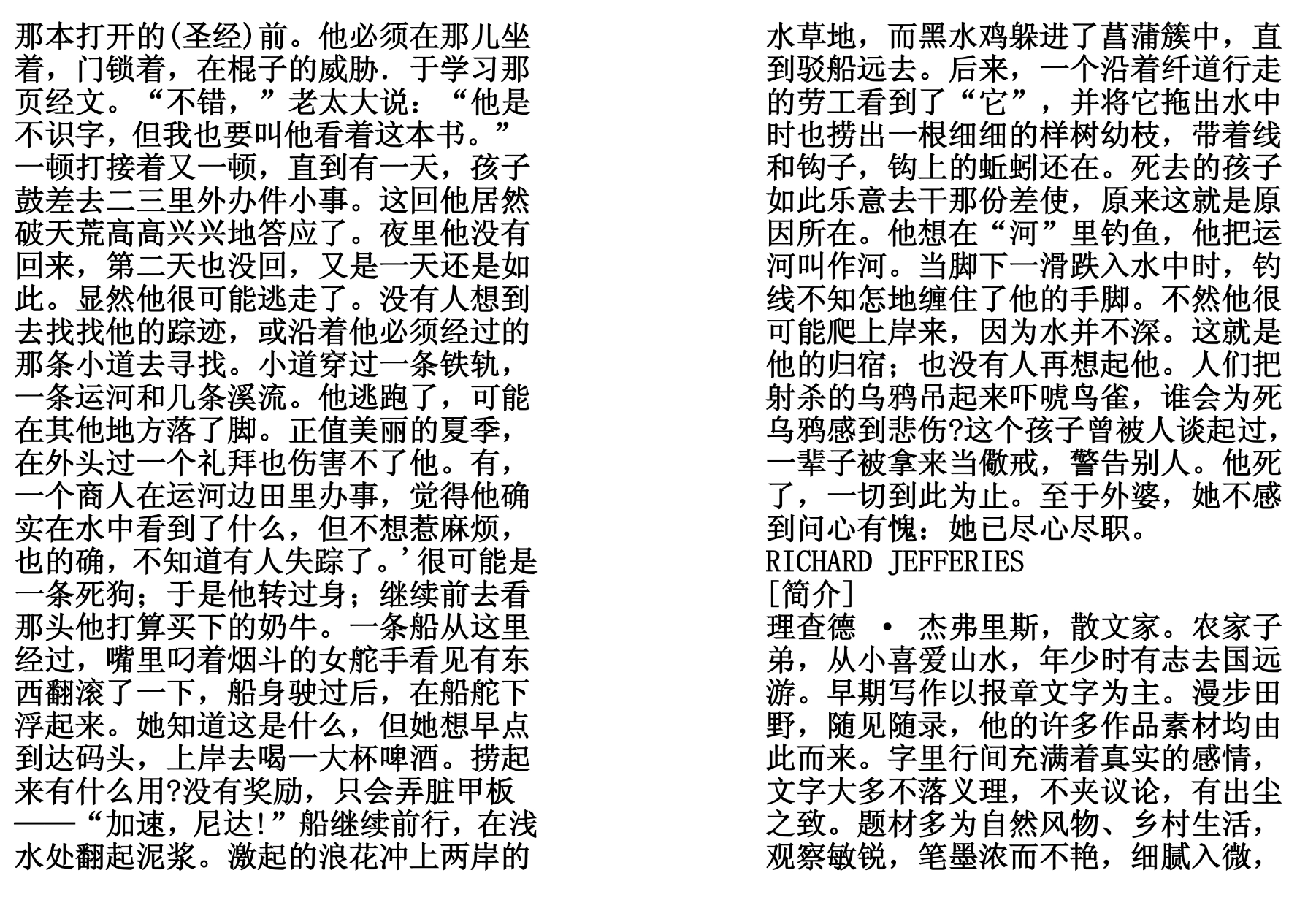
7 A footpath which crossed the field went by the cottage and every Sunday those who were walking to church could see the boy in the window with granny’s Bible open before him. There he had to sit, the door locked, under terror of stick, and study the page. What was the use of compelling him to do that? He could not read. “No,” said the old woman, “he won’t read, but I makes him look at his book.”
8 The thwacking went on for some time, when one day the boy was sent on an errand two or three miles, and for a wonder started willingly enough. At night he did not return, nor the next day, nor the next, and it was as clear as possible that he had run away. No one thought of tracking his footsteps, or following up the path he had to take, which passed a railway, brooks, and a canal. He had run away, and he might stop away: it was beautiful summer weather, and it would do him no harm to stop out for a week. A dealer who had business in a field by the canal thought indeed that he saw something in the water, but he did not want any trouble, nor indeed did he know that some one was missing. Most likely a dead dog; so he turned his hack and went to look again at the cow he thought of buying. A barge came by, and the steerswoman, with a pipe in her mouth, saw something roll over and come up under the rudder the length of the barge having passed over it. She knew what it was, but she wanted to reach the wharf and go ashore and have a quart of ale. No use picking it up, only making a mess on deck, there was no reward – “Gee-up! Neddy.” The barge went on, turning up the mud in the shallow water, sending ripples washing up to the grassy meadow shores, while the moorhens hid in the flags till it was gone. In time a laborer walking on the towing-path saw “it,” and fished it out, and with it a slender ash sapling, with twine and hook, a worm still on it. This was why the dead boy had gone so willingly, thinking to fish in the “river”, as he called the canal. When his feet slipped and he fell in, his fishing-line somehow became twisted about his arms and legs, else most likely he would have scrambled out, as it was not very deep. This was the end; nor was he even remembered. Does any one sorrow for the rook, shot, and hung up as a scarecrow? The boy had been talked to, and held up as a scarecrow all his life: he was dead, and that is all. As for granny, she felt no twinge: she had done her duty.
翻译
讲解1
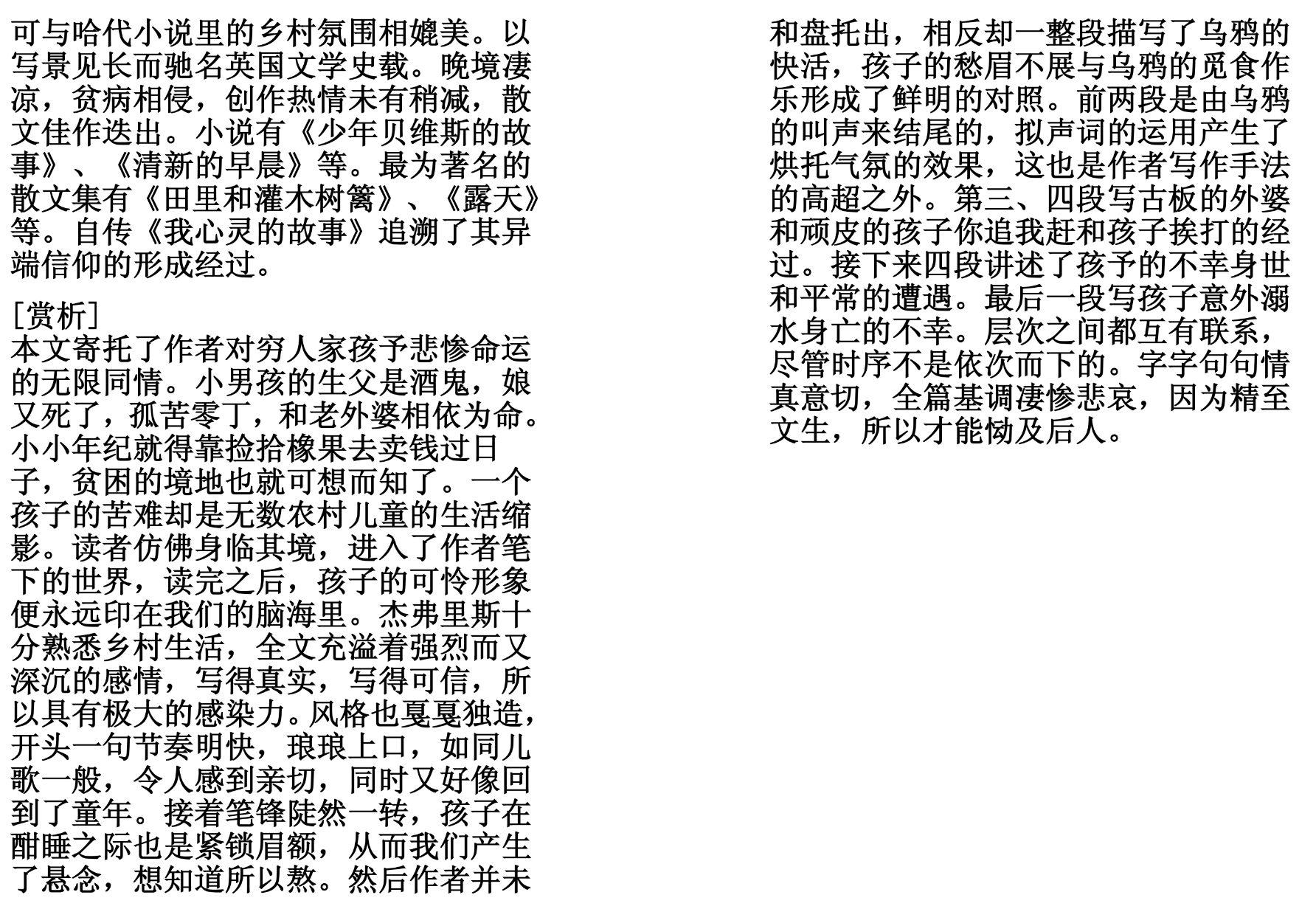
理查德·杰弗里斯(1848—1887)是英国自然作家、小说家和散文家。他丰博的自然知识及作品中关于自然的诗意描写使他成为自然主义者们推崇的先驱。在散文集《田野的生活》(1884年)中,作家生动呈现了英格兰的自然风光,原始的生态环境和维多利亚时代的乡村生活。其中短篇故事《捡橡果的孩子》讲述的就是这个时代某个落后村庄中一个十岁私生子的悲剧故事。 捡橡果者之死
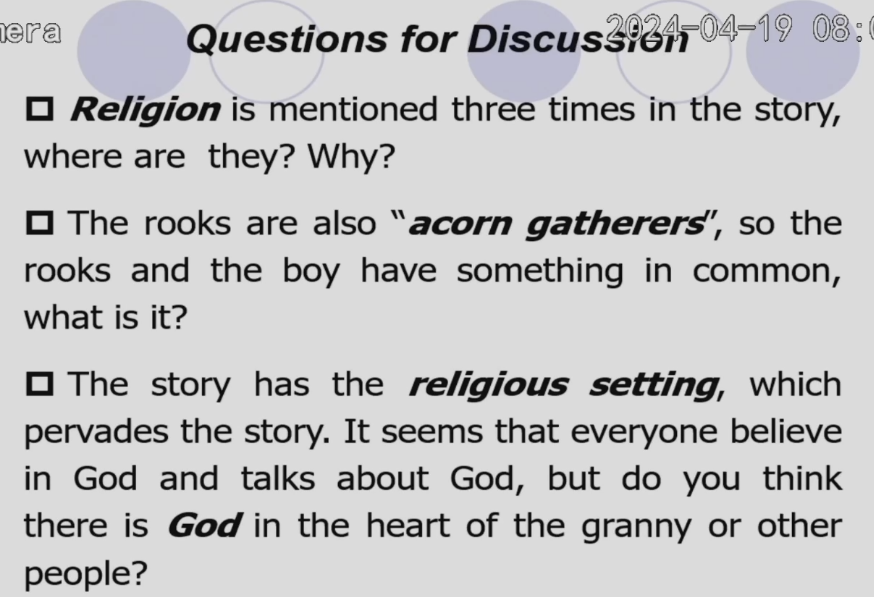
《捡橡果的孩子》中频繁指涉了乌鸦的意象,文中多处将男孩和乌鸦并置。首先,标题“The Acorn Gatherer” 除指这个捡橡果的孩子外,也并指乌鸦。杰弗里斯在第一句描绘了一副美丽的乡村图景:“黑乌鸦,黄橡叶,树下睡着一个小男孩。”[1]这个男孩旁边有半包橡果。树上的乌鸦“是天下最快乐的生物”,在丰硕的果实面前,它们欢快地找着,吃着,“扯开最大嗓门大吹大擂”。[1]然而,不论是乌鸦还是男孩却都受到村民的嫌恶。杰弗里斯曾在他一篇散文《自然和猎场看守人》中提出:“乌鸦……猎场看守人、打猎者、农民,但凡跟乡村生活沾边的人都憎恨它们。”[2]这个男孩也受到同样待遇,连男孩的外婆也觉得“世界上没有再坏的孩子了:这个坏蛋已不可救药”,并且“不再因为一时的某种怒气,而是出于习惯要揍他一顿,就像汲水灌壶一样,已成为家常事了”。[1]此外,男孩和乌鸦在村民的生活中都被认为是“稻草人”[1]。人们把射杀的乌鸦如“稻草人”一样吊起来吓唬鸟雀,而男孩呢,“一辈子被拿来当儆戒,警告别人”[1]。“稻草人”这个意象指涉的是男孩的私生子身份带来的罪孽,它揭示了男孩的存在仅仅是罪与警示的象征。小说中无人为乌鸦之死伤感,同样,男孩死后“无人还记得他”,就连其外婆也没有悲伤,而是觉得把他照顾得很好了,“不感到问心有愧”[1]。
乌鸦是被不同种族杀死的(小说中是被人类射杀),而男孩之死是因为同族。乌鸦被射杀是因为它们对人类的农业和食物链造成了威胁。它们的尸体被制成稻草人来警告其他鸟类。我们很容易理解人类杀死乌鸦来保护粮食的行为,但外婆和村民对男孩之死的冷漠和残忍就有点背离常规了。毕竟包括人类在内的每一种族都有试图保护后代,延续后代的天性。而男孩,作为外婆的血亲和下一代本应该被保护和照顾,但是他却每天挨打,在他离家出走之后,没人试图去找他。对一个十岁的孩子而言,在野外生存的几率是渺茫的,但是村民们却认为“正值美丽的夏季,在外头过一个礼拜也伤害不了他”[1]。换言之,村民任其自生自灭。他们对人命如同对动物一样冷漠。对于他的死,村民并没有惋惜或悲痛,人们发现尸体时的麻木无情被描绘得入木三分。一个商人觉得他在水中看到了什么,但他不想找麻烦,所以自我安慰说“很可能是一条死狗”;一个女舵手看到了并且“知道这是什么”, 但由于“没有奖励,只会弄脏甲板”,所以她命令驳船继续前行。最后,“一个沿着纤道行走的劳工看到了 “它”,并将“它”拖出水中。[1]村民认为“他死了,一切到此为止”[1],男孩的死与乌鸦刍狗之类的动物之死无异。
如果杰弗里斯会替人类残杀的动物抱不平,那么杰弗里斯也定会为文中的乌鸦和男孩之死感到伤心,但是作者却巧妙地把这伤心隐藏在文本的不可靠叙事背后,引导读者自己去发现真相。小说是以第三人称作为叙述视角,叙述者对整个故事的叙述态度让人联想到了一个外村人经过从村民口中道听途说了这个故事,而村民们讲述男孩之死时不免带着偏见,叙述者就这样不加评判地重述了故事,所以,整个叙述的可信度值得商榷,文本也多处自相矛盾。比如,在叙述者转述外婆的描述时,男孩是世界上最坏的“坏蛋”,且“已不可救药”[1],而十岁的男孩实际上并没有做过什么所谓的坏事,充其量不过是个在打骂虐待和缺少爱的环境中长大的小叛逆者。叙述者也客观描述,不加评判地传达了村民的声音,认为孩子的死亡“就是他的归宿”,外婆“已尽心尽职”[1],这一评价跟那个随便打骂孩子、置孩子生死于不顾的外婆显然有出入。在一系列矛盾的、甚至是违反常理的话语中,叙述者及村民对生命的漠视与杰弗里斯及读者对生命的珍爱两种理念相碰撞,冲击了读者的常识和认知。叙述的不可靠和文本的不确定性引起了读者的疑问,激发了读者的思考,引导读者去颠覆文本,重构故事,还原真实,并最终探索出男孩的真正死因。 十字架下的人性
这个故事发生在维多利亚时代的一个落后的小村庄。维多利亚时代是英国工业、文化、政治、科学和军事大变革的时代。贝利认为宗教道德观在维多利亚时代也经历了大变革。当维多利亚继位时,英国国教权力很大,可以开办学校甚至大学,高级的教职人员占据着国会上议院的席位。但是自从1859年查尔斯·达尔文的《物种起源》发表后,在工业化城市,教会的权力和市民的信仰都遭遇了“信仰危机”。演化论基于大量事实,引发了对宗教信仰和维多利亚价值观的质疑。[3]
在小说中,外婆本是个苦命人,是一个贫穷的劳动妇女。她的丈夫未曾被提到,很可能多年前已去世。她的女儿“据说是活活饿死的”[1],还留下一个私生子,而孩子的父亲是个酒鬼,宁可花钱在酒上也不愿抚养儿子。外婆和男孩过得很拮据。这个十岁的男孩“衣服不比麻布片好多少”[1],而且他还要摘橡果卖钱来补贴家用。然而,比贫穷更折磨外婆的是她死去女儿的罪孽。《圣经·希伯来书》说,“婚姻,人人都当尊重,床也不可污秽。因为苟合行淫的人神必要审判。”她女儿非婚生子,违背了基督教教义和维多利亚社会规范,也必然给外婆的声誉留下不可磨灭的污点,更何况,女儿的罪行之果——这个男孩还跟外婆一起生活,如同一团乌云罩顶,外婆的生活没有光芒和希望。她很可能受到了内外的煎熬,在内,她虔诚的宗教信仰让她无法接受女儿和外孙竟是亵渎上帝的人,在外,村民对她的议论和孤立也给她带来了很大的痛苦。
外婆收养和虐待男孩都跟她的宗教信仰不无关系。外婆很可能感受到了宗教的压力,要她为了她女儿,她外孙甚至她自己来获取个人救赎。作为一个虔诚的基督徒,她很可能对女儿临死前的求助无动于衷,不肯提供任何帮助。然而,抛弃年幼的孙子在村民眼中则是另一桩罪行,所以她不得不接纳了他,对外婆而言,抚养外孙也是一次全新开始的机会,是一个在村民面前证明自己的机会。事实上,她这一行为的确赢得了村民的好评,在别人看来她“已尽心尽职”。比如,男孩的衣服虽然不比麻布片好多少,但缝补洗刷得干净整洁,谁都会说:“家境不好,但照料还挺仔细”[1]。 另外,她很可能曾一度认为她的外孙,一个小孩子,并非无药可救,而且教导他归顺上帝也是她的“责任”[1]。于是,她不但养育他,还试图把他培养成上帝的子民,对上帝绝对地忠诚和顺服。当然,首先要对外婆绝对地顺服。当他长大了,她把他锁在房间里,不顾他不认字的事实,拿着棍子强迫他“看着”圣经,而且她还让他坐在“去教堂的人都可以从窗前看到”[1]的窗户那里。这种行为近乎愚蠢和可笑,连村民都劝她这样做没意义,但外婆一方面已经被救赎的心态蒙蔽的双眼,根本不觉得她对男孩的强迫,挨饿和打是一种虐待,而是对她外孙和死去女儿的罪过的一种救赎行为,所以不肯改变,另一方面,很可能外婆是为了做给村民看,自己是可以成为一个合格的家长,教育出虔诚的孩子。当他不听话,她就打他,饿他,甚至会扛一捆柴“扛了四分之一英里路”[1],就为了堵住他的逃路,“两次得手,狠狠治了他一下”[1]。 她恨铁不成钢虽能理解,可是,一个十岁的男孩根本不该受这个待遇,毕竟,小说中他所做的所有的坏事也只不过是捡橡果时睡着,或者被打时为了报复外婆,拿起那半袋橡果,扔进池塘之类的小事而已。但是随着时间流逝,外婆“她不再因为一时的某种怒气,而出于习惯要揍他一顿”[1]。此时的外婆虽不能说丧失心智,但已演变成近乎疯狂的施暴者。
不幸的是,外婆的教育结果是失败的。读者一点也不会意外地看到男孩长成一个叛逆者,“榜样、规劝和棍棒都改变不了这个男孩的心”[1]。在尝试了多种方法后,外婆放弃了,认为“这个坏蛋已不可救药”[1]。这正是她在他逃走后不愿再去找他回来的原因。终于,男孩的死让外婆从责任和罪孽的乌云中解脱出来,“她自觉的正义感”[1]也终于能休息了。
所有这些对男孩不公正的评价,残忍的甚至是非人道的虐待都是由一个不可靠的叙事者来叙述的,叙事者选择了相信村民和外婆的叙述,冷漠地用她的理由来解释她的行为的正义性。然而,正是这种不可靠的和不合逻辑的叙述使故事显得荒诞,让读者深思男孩的真实境遇和维多利亚时代的真实社会。这种叙事和现实之间的差异和矛盾影射了基督教义的道德价值的荒诞性和十字架下人性的扭曲。 维多利亚时代性别歧视的受害者
杰弗里斯可能并未意识到男孩的妈妈和奶奶都是维多利亚父权社会的受害者。杰弗里斯是同情男孩的。在故事中,男孩因其非婚子的出身一生被视为稻草人,用来警告他人。男孩被描述成一个失语的叛逆者,他的一生无助且注定是个悲剧,而外婆被描述成了压迫者,她虔诚到愚昧,严厉到无情。在写作时对材料的筛选、删除和重构的过程中,杰弗里斯也给读者留了一个很大的空白去填补,那就是,男孩母亲的故事。毫无疑问,她的故事只能是个悲剧。因为母亲的悲剧是男孩悲剧的开始,对母亲死因的分析也是必要的。
男孩的母亲是维多利亚时代性别歧视的受害者。杰弗里斯在文中未曾提到根据法律规定,男孩的母亲在法律上和经济上承担男孩的抚养,而她死后,男孩的外婆也要抚养他,男孩的父亲则对非婚怀孕和这个男孩不负有任何法律责任。法律的制定是保护男人利益的。父亲在法律上被免除了抚养男孩的责任,而母亲却正相反。这就导致了一个悲剧的结果——我们不难推断出,男孩的母亲一定在抚养孩子的时候经历了经济危机才会活活饿死。而上文已讨论过,外婆很可能因为自己的宗教信仰拒绝向女儿提供支持,考虑到父亲在男孩被外婆习惯性虐打也不肯干预,仅仅因为“他一干涉,就必须领养孩子每星期得损失好几先令啤酒钱”[1]的情况,可以推断出,男孩的父亲也同样拒绝给男孩母亲提供足够的经济帮助。在小说中,杰弗里斯简单提到了一个不负责任的父亲,但从未有任何提示读者维多利亚时代的法律是支持父亲这样做的内容。
外婆也同样是维多利亚时代性别歧视的受害者。假如非婚生子的女人不被法律和人们歧视,假设男人被强制一起承担非婚子的经济抚养,男孩的母亲也许不会被活活饿死,外婆也可能不会仅仅因为男孩的存在时刻提醒她女儿的罪而虐待他。就算外婆抚养孩子仅仅是出于法律责任或者宗教压力,而不是出于爱或者同情,不可争辩的事实是,这个年迈的、虔诚的、贫穷的老人失去了她的至亲——她付出毕生精力和金钱抚养大的女儿和外孙。的确,外婆在小说结尾并没有悲剧地死去,并且还摆脱了抚养男孩的责任,但她将终身背负十字架,活在扭曲的人性里。表面上看,外婆和父亲是应批判的对象,然而,维多利亚时代的宗教信仰和性别歧视才是导致了祖孙三代悲剧的根本原因。从本质上说,这个悲剧是维多利亚时代的人性悲剧。
[1]Jefferies, Richard. The Acorn-Gatherer [A].英语短篇小说教程[M].虞建华编.北京:高等教育出版社,2010:142-145.
[2]Jefferies,Richard.The Life of the Fields[M].Ed.S.J.Locker.London:Chatto and Windus,1891.
[3]Bayley,S.Victorian Values:An Introduction[M].Montreal:Dawson College,2008:108-113.
yf的资料
The Acorn-Gatherer
*Themes*:
-
Nature and Its Influence: Given the title "The Acorn-Gatherer," it's likely the story would explore the theme of nature and its impact on human life. The gathering of acorns could symbolize a simple, harmonious existence with nature.
-
Class and Social Structure: As in many of Galsworthy's works, themes of class distinctions and the impact of social structures might be prominent. The story could contrast the simple life of a rural individual with the complexities of urban or upper-class society.
-
Tradition vs. Change: Galsworthy often explored the tension between traditional values and the changing social landscape. "The Acorn-Gatherer" might delve into how a traditional way of life is challenged or altered by societal changes.
-
Individual vs. Society: The protagonist's role as an acorn gatherer might serve as a metaphor for an individual's place in society, highlighting themes of individualism, self-sufficiency, and the conflict between personal desires and societal expectations.
-
Moral Reflections: The story could also include a strong moral dimension, reflecting on the values of hard work, perseverance, and the inherent rewards of a life close to nature.
*Settings*:
-
Geographical Setting:
-
Rural England: Jefferies' works are predominantly set in the English countryside. The geographical setting for "The Acorn-Gatherer" would likely be a rural area, possibly in or near Wiltshire, where Jefferies spent much of his life.
-
Natural Landscapes: The story would likely feature detailed descriptions of natural landscapes, such as woodlands, fields, and meadows, reflecting Jefferies' deep appreciation for and understanding of nature.
-
Historical Setting:
-
Late 19th Century: Jefferies wrote during the late Victorian era, so the historical setting for "The Acorn-Gatherer" would likely be in the latter half of the 19th century. This period was marked by significant social and technological changes, contrasting the rural, pastoral life with the rapidly industrializing cities.
-
A Time of Agricultural Change: The era was also a time of change in agricultural practices and rural life in England, which could be reflected in the story's setting and themes.
-
Social Setting:
-
Rural Community Life: The social setting might focus on the dynamics of a small, close-knit rural community, typical of the English countryside during this period.
-
Class and Social Structures: The story could explore the class dynamics and social structures of the time, perhaps contrasting the simplicity of rural life with the more complex social hierarchies of urban areas.
-
Human Connection to Nature: Reflecting Jefferies' interest in the human-nature relationship, the social setting might also delve into how people's lives were intimately connected to and dependent on the natural world, a theme prevalent in his writings.
In summary, "The Acorn-Gatherer" would likely be set in a richly described rural English landscape of the late 19th century, with a focus on the social dynamics of rural life and the deep connections between humans and nature that were characteristic of Richard Jefferies' works.