2.The Washwoman
课本页数: 33 作者: I.B.Singer
往届考过的大题
第 1 小题:什么是 short story ,请结合本文阐释一下 short story 的特色(p2,需要背一下short story 本身的特点以及与其他文学体裁的区别,再结合小说)
Fiction is a general term that can be defined as a narrative told in prose, Therefore, fiction refers to different types of writing and it is most often associated with short story.
特点
short stories embody some of our basic interests, needs and desires buried deep in the human psyche. (This article reflects our interest in the lives of the common people at the grassroots level.)
The short story, with "story"being defined by the word "short," is necessarily limited in length and scope. A short story usually concentrates on a single incident and portrays a single character or a few characters. (This article mainly focuses on the character of the washwoman, and the story it tells is relatively simple.)
The meaning production is the result of the reader's life experience, and a short story also enriches readers' life experience. A short story does not mean the same to every reader, as the reader's own life experience can enrich, expand and reshape the meaning of it. (Different people have different perceptions of the protagonist. Some believe the washwoman is diligent and hardworking, while others think she has chosen an unnecessarily difficult path.)
第 2 小题:为什么小说以小男孩的叙述视角展开?(涉及文学常识是叙述者视角 p22,本篇小说是无知者叙述视角)
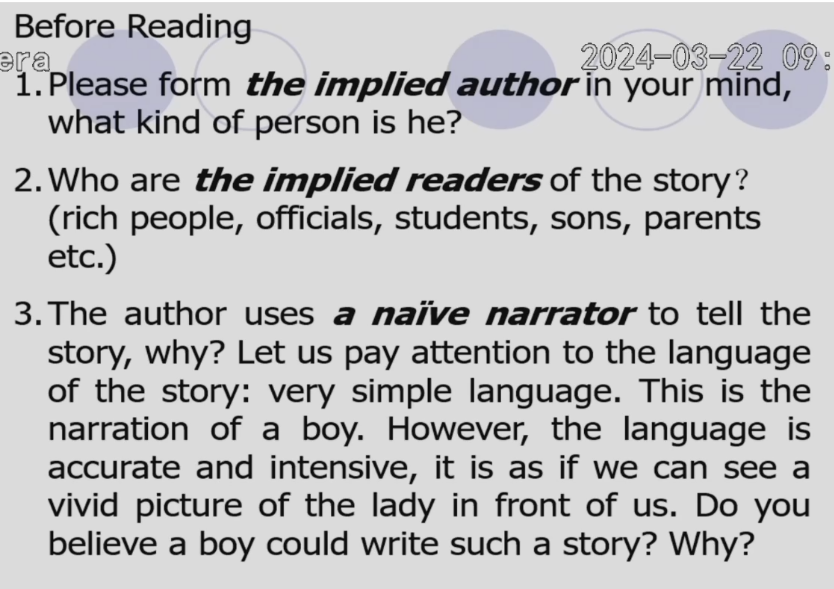
The story "The Washwoman" is narrated from the perspective of a young boy, which is known as an "innocent narrator" or "naïve narrator." : The young boy’s perspective brings a sense of purity and straightforwardness. His observations are free from the biases and complexities that come with adulthood, making the story feel more genuine and touching. He views the washwoman through the innocent eyes of a child, without the detached coldness or excessive pity that an adult might have.
A child's perspective easily evokes sympathy and empathy from readers. Through the young boy's narration, readers are more likely to feel the hardship and resilience of the washwoman, thereby gaining a deeper understanding of her life situation and inner world.
The use of an innocent narrator can enhance the emotional impact of the story. The boy’s genuine concern and admiration for the washwoman can make her struggles and ultimate fate more poignant and impactful for the reader.
The boy’s perspective emphasizes the washwoman's strength and dignity. His admiration and respect for her labor and perseverance make her character stand out more vividly. The innocence of the narrator allows readers to see the washwoman’s virtues without the influence of societal judgments.
The story thus leaves more room for exploration, becomes more interesting and involves the reader more deeply to excavate the meaning that the naïve narrator fails to reach
第 3 小题:小说的主题是什么?(小说主题相关的文学常识在书 p62,每篇小说的主题 ppt 上会给)

Key themes in "The Washwoman" include:
- *Dignity in Labor: The washwoman represents the dignity of labor, showing pride and dedication in her work despite its menial nature and the physical toll it takes on her.
- *Resilience and Perseverance: She exemplifies resilience and perseverance, continuing to work hard even as she ages and faces personal hardships. Her character is a testament to the strength of the human spirit.
- The Intersection of Cultures: The essay also touches upon the interactions between Jewish and non-Jewish communities in Poland. The washwoman, being a non-Jew working for a Jewish family, represents a bridge between different cultures and traditions.
- The Value of Human Connection***: Despite her solitary life and the hardships she endures, the washwoman's interactions with the author's family highlight the importance and value of human connection and kindness.
另一份生成的: The theme of "The Washwoman" revolves around themes of dignity, resilience, and the human spirit. The story highlights the washwoman's unwavering dedication to her work and her refusal to become a burden to others, even in the face of extreme hardship and old age. It also touches on themes of familial neglect, as seen in the washwoman’s relationship with her son, contrasting with her own sense of duty and pride. Additionally, the story reflects on the moral and ethical values of hard work, perseverance, and integrity, portraying the washwoman as a symbol of enduring strength and dignity in the face of life's challenges.
正文
这个和课本上那篇好像有一点不太一样,主要集中看一下前几段。(好像网上有很多个版本,底下的文字是课本上版本的)
Our home had little contact with Gentiles. But there were the Gentile washwomen who came to the house to fetch our laundry. My story is about one of these.
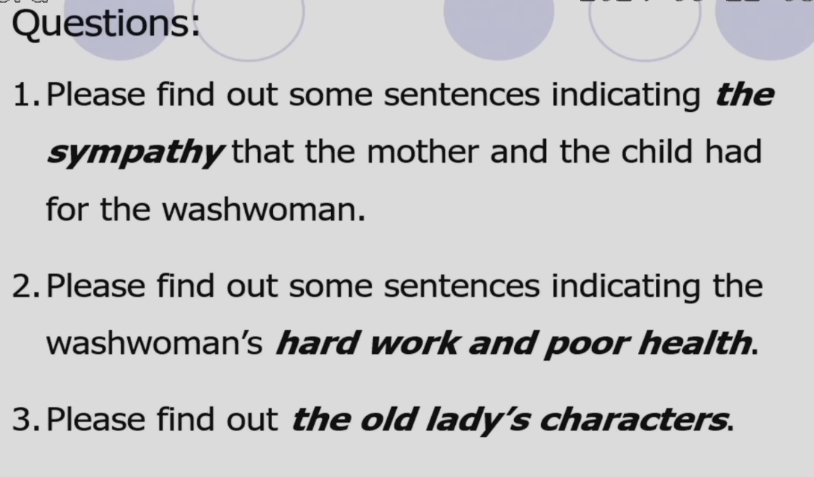
She was a small woman,old and wrinkled. When she started washing for us, she was already past seventy. Most Jewish women of her age were sickly, weak, broken in body. But this washwoman,small and thin as she was, possessed a strength that came from generations of peasant ancestors. Mother would count out to her a bag of laundry that had accumulated over several weeks. She would lift the heavy bag, load it on her narrow shoulders, and carry it the long way home. It must have been a walk of an hour and a half.
She would bring the laundry back about two weeks later. My mother had never been so pleased with any washwoman. Every piece of laundry was as clean as polished silver. Every piece was neatly ironed.Yet she charged no more than the others. She was a real find. Mother always had her money ready because it was too far for the old woman to come a second time.
Washing clothes was not easy in those days. The old woman had no tap where she lived, but had to bring in the water from a pump. For the clothes and bedclothes to come out so clean, they had to be scrubbed thoroughly in a washtub, rinsed with washing soda,soaked,boiled in an enormous pot,starched,then ironed. Every piece was handled ten times or more. And the drying! It had to be hung in the attic.
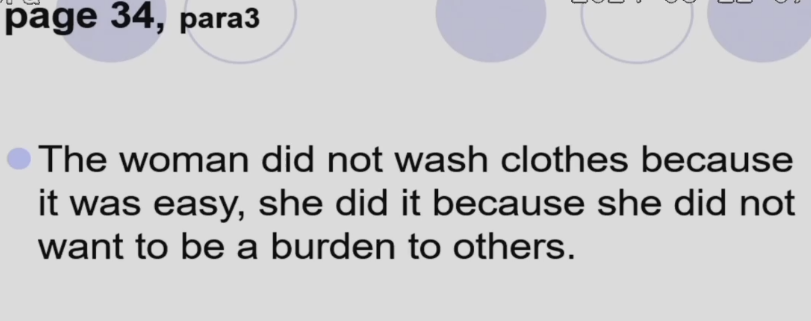
She could have begged at the church door or entered a home for the poor and aged. But there was in her a certain pride and love of labor with which many Gentiles have been blessed. The old woman did not want to become a burden, and so bore her burden.
The woman had a son who was rich. I no longer remember what sort of business he had. He was ashamed of his mother, the washwoman,and never came to see her. Nor did he ever give her any money. The old woman told this without bitterness. One day the son was married. It seemed that he had made a good match. The wedding took place in a church. The son had not invited the old mother to his wedding, but she went to the churchand waited at the steps to see her son lead the "young lady" to the altar...
The story of the faithless son left a deep impression on my mother. She talked about it for weeks and months. Mother would argue,"Does it pay to make sacrifices for children? The mother uses up her last strength, and he does not even know the meaning of loyalty.
That winter was a harsh one. The streets were icy. No matter how much we heated our stove,the windows were covered with frost. The newspapers reported that people were dying of the cold Coal became dear. The winter had become so severe that parents stopped sending children to school.
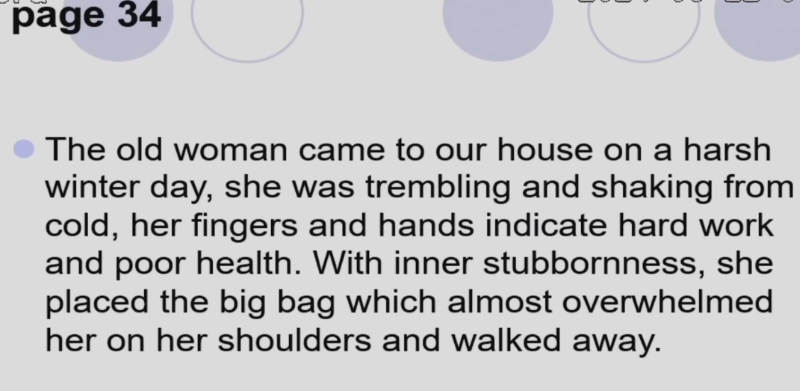
On one such day the washwoman, now nearly eighty years old, came to our house. A good deal of laundry had accumulated during the past weeks. Mother gave her a pot of tea to warm herself as well as some bread. The old woman sat on a kitchen chair trembling and shaking, and warmed her hands against the teapot. Her fingers were rough from work,and perhaps from arthritis, too. Her fingernails were strangely white. These hands spoke of the stubbornness of mankind,of the will to work not only as one's strength permits but beyond the limits of one's power.
The bag was big, bigger than usual. When the woman placed it on her shoulders, it covered her completely. At first she stayed,as though she were about to fall under the load. But an inner stubbornness seemed to call out: No, you may not fall. A donkey may permit himself to fall under his burden, but not a human being,the best of creation.
She disappeared, and mother sighed and prayed for her.
More than two months passed.The frost had gone,and then a new frost had come, a new wave of cold. One evening, while Mother was sitting near the oil lamp mending a shirt, the door opened and a small puff of steam, followed by a gigantic bag, entered the room. I ran toward the old woman and helped her unload her bag. She was even thinner now, more bent. Her head shook from side to side as though she were saying no. She could not utter a clear word, but mumbled something with her sunken mouth and pale lips.
After the old woman had recovered somewhat she told us that she had been ill. Just what her illness was, I cannot remember. She had been so sick that called a doctor, and the doctor had sent for a priset. Someone had informed the son, and he had contributed money for a coffin and for the funeral. But God had not yet wanted to take this soul full of pain to himself. She began to feel better, she became well, and as soon as she was able to stand on her feet once more, she began her washing. Not just ours, but the wash of several other families, too.
"I could not rest easy in my bed because of the wash, " the old woman explained."The wash would not let me die."
"With the help of God you will live to be a hundred and twenty, "said my mother,as a blessing.
"God forbid! What good would such a long life be? The work becomes harder and harder... my strength is leaving me... I do not want to be a burden on anyone! " The old woman crossed herself,and raised her eyes toward heaven.
Fortunately there was some money in the house and Mother counted out what she owed. Then she left, promising to return in a few weeks for a new load.
But she never came back. The wash she had returned was her last effort on this earth. She had been driven by an indomitable will to return the property to its rightful owners, to fulfill the task she had undertaken.
And now at last her body, which had long been supported only by the force of honesty and duty, had fallen. Her soul passed into those spheres where all holy souls meet, regardless of the roles they played on this earth, in whatever tongue, of whatever religion. I cannot imagine paradise without this Gentile washwoman. I cannot even imagine a world where there is no reward for such effort.



yf的资料
The Washwoman
"The Washwoman" is a narrative essay by Isaac Bashevis Singer, a Nobel Prize-winning author known for his poignant and rich depictions of Jewish life in Poland. The essay is a tribute to an elderly Jewish washwoman who worked for the author's family when he was a child.
The story is notable for its themes of dignity, resilience, and the human capacity for hard work, even in the face of adversity. The washwoman, despite her advanced age and the physical demands of her job, is portrayed as a figure of extraordinary strength and moral fortitude.
Key themes in "The Washwoman" include:
- *Dignity in Labor: The washwoman represents the dignity of labor, showing pride and dedication in her work despite its menial nature and the physical toll it takes on her.
- *Resilience and Perseverance: She exemplifies resilience and perseverance, continuing to work hard even as she ages and faces personal hardships. Her character is a testament to the strength of the human spirit.
- The Intersection of Cultures: The essay also touches upon the interactions between Jewish and non-Jewish communities in Poland. The washwoman, being a non-Jew working for a Jewish family, represents a bridge between different cultures and traditions.
- The Value of Human Connection***: Despite her solitary life and the hardships she endures, the washwoman's interactions with the author's family highlight the importance and value of human connection and kindness.
"The Washwoman" is a moving portrayal of a seemingly ordinary life marked by extraordinary character and resilience. Singer's narrative is a powerful reminder of the often-overlooked dignity in everyday labor and the enduring human spirit in the face of life's challenges.
In Isaac Bashevis Singer's "The Washwoman," the narration and the narrator play crucial roles in conveying the story's themes and emotional depth.
2.*Narrator's Perspective*: The narrator in "The Washwoman" is an adult reflecting back on his childhood experiences. This retrospective perspective allows the narrator to provide insights and reflections on the events and characters that a child might not fully understand or appreciate. The adult narrator can see the washwoman's life and labor in a broader social and moral context, adding layers of meaning to the narrative.
- Personal Connection to the Washwoman: The narrator has a personal connection to the washwoman, as she worked for his family when he was a child. This personal connection adds a layer of authenticity and emotional depth to the narrative. The narrator speaks of the washwoman with a mix of admiration, gratitude, and sadness, reflecting on the lessons he learned from observing her life and work.
- Narrator as a Character: The narrator is also a character in the story, albeit a minor one compared to the washwoman. His reflections on his family's interactions with the washwoman, and on his own feelings and observations, offer a window into his own growth and moral development. The narrator's character serves as a bridge between the reader and the washwoman, guiding the reader's understanding and emotional response to her story.
In summary, the narration and the narrator in "The Washwoman" are integral to the story's effectiveness. Singer's use of a reflective, personal, and empathetic narrative voice allows the reader to connect deeply with the story and its themes, making "The Washwoman" a poignant and enduring piece of literature.